


So let me say the disclaimer up front, because I don’t want anyone reading this the wrong way.
This isn’t a takedown.
I’m not naming names or airing grievances or building some big moment where I torch a company on my way out the door.
I genuinely loved my time at Adobe. I grew more there than almost anywhere else in my career; the people were fantastic, and the company genuinely supported its people.
If you’re looking for tea, this isn't that article. No Scarface from Half Baked moments here.
What I want to talk about is the decision itself. The thinking that got me from “I’m happy here” to “It’s the right time for me to leave.”
Let’s get into it.
The moment that isn’t a moment
Here’s what surprised people when I told them I was leaving: there wasn’t an incident. No blowup, no ultimatum, no single Tuesday where I decided I was done. It was quieter than that, a nagging thing sitting in the back of my head for a while before I gave it any real attention. I’ve written before about how murky that decision usually is, and this was no exception. There was no villain forcing my hand.

A mentor at Adobe once gave me a question that ended up doing most of the work for me. He said,
“Whenever you’re weighing a career move, ask yourself if you’re running away from something or running toward something.”
Are you running away from a bad boss, a stalled title, a lousy comp bump? That’s usually a sign you’re not actually making a wise decision. You’re just trying to escape. Running toward something is different. Running toward something means you are doing something you are passionate about. Something inevitable that you overcome obstacles to complete.
I sat with that question for a while, and the answer was that I wasn’t running from anything at Adobe. I wanted to run toward the chance to help build something from an earlier stage and have a voice in the process.
A Beat Too Late
I hit the 5-year mark at Adobe, and I thought that was a good moment to take a breath and look at the big picture of my career.
I’d had a good run. But my entire eighteen-year career in 3D has happened at massive companies. Blue Sky Studios, which was owned by 20th Century Fox and later Disney. Then the Substance 3D team at Adobe. That’s it.
Again…not a takedown article. There’s nothing wrong with those big companies. But at both stops, I joined companies after they were already successful and missed their heyday/special moment.
I joined Blue Sky during Ice Age 3. Years after the booming success of the original Ice Age, I only heard stories about the remarkable rise of this spunky little studio on the wrong coast. Then I joined the Substance 3D team after Adobe had already acquired it. There, I heard the epic stories of scrappiness, ingenuity, and camaraderie that helped them reach that level.
Both times, I arrived after the defining early chapter had already been written.
I felt like I was always showing up a beat too late. It’s like going to Woodstock and showing up after Hendrix played.

Or it’s like a weekend trip with friends where everyone gets wild the first night and you don’t roll in until the second, and you spend the whole trip hearing about a story you weren’t in.
I’d built a career being very good at joining things other people had already built and helping maintain that success. What I’d never done was help build it.
The State of the Industry
Another part of what I was running toward was a read on where creative work is heading right now. I don’t think this is a dire moment for creative professionals. I believe AI is changing the way we work, but it is not changing the need for creative professionals. It’s just a moment of instability where things are shifting fast. I want to be part of a smaller, more nimble company that can adjust to those shifts.
I also have a strong belief about where the next real bottleneck in this industry sits, and it isn’t in the tools that make things. It’s in what happens after. Every generative tool, every DCC, every AI pipeline is getting faster and better at producing content. Almost none of them are solving how you store it, find it again, and actually use it in new ways. Asset management is becoming the next Achilles heel of the creative industry, and it’s only getting more urgent as content generation accelerates.
Why KitBash3D?
Years ago, I was teaching a lighting class when a student showed up with a super cool Victorian city that looked way better than anything else they had produced up to that point.

I asked where he got it. It turned out it was from a brand-new company I had not heard of yet, called KitBash3D. I looked at their website and saw they had a bunch of really cool textured models, so I reached out cold through their contact form, basically asking if my students could get access to some assets to light. The co-founder, Banks, answered personally and said yes without hesitation.
That started a relationship that ran for years before I ever considered working there. At SIGGRAPH, GDC, or whenever our paths crossed, we found time to meet up.
Over that time, I watched Banks and the team build quality assets and a culture in a way I’ve heard plenty of leaders describe and almost never actually deliver. Banks would proudly talk about his company’s culture, and it never once felt like lip service. It felt like something he believed in his bones, and it showed in how the company actually operated. The conversations always ran long, and I’d walk away fully inspired, feeling an inch or two taller.
I Snooped
Before I said yes to anything, I wanted to find any good reason to not make this move. So I get to snooping.

I Googled. I read through Glassdoor. I downloaded Cargo myself and pushed every edge case until something broke, and I contacted customer support to see how a real problem got handled on the other end.
KitBash3D had already brought Greyscalegorilla into the fold by then, so I went further and asked motion designers I knew who’d actually used Greyscalegorilla’s tools and community what their experience had been.
Every answer came back the same. Different people, different relationships to the company, no coordination between any of them, and still the same story. “Oh, those guys are great. Love working with them.”
So I’m in Business Development? Like I’m a Businessman? Or am I a Business…man?
A bit of a sidebar but people have asked me some version of the same thing since I made the move: you were an artist, now you’re on the business side, how does that work?
The classic idea of sales is being able to sell anything to anybody, right?
“I can sell water to a fish.” or “I can sell a ketchup popsicle to a woman wearing white gloves.”
(Side note - I honestly thought that was a real saying…I was just told it was a quote from Tommy Boy. Thank you to my buddy Brad for calling that out for me. Turns out I took a movie I have seen a dozen times and turned it into a real memory in my dumb brain. Humans are a weird animal.)
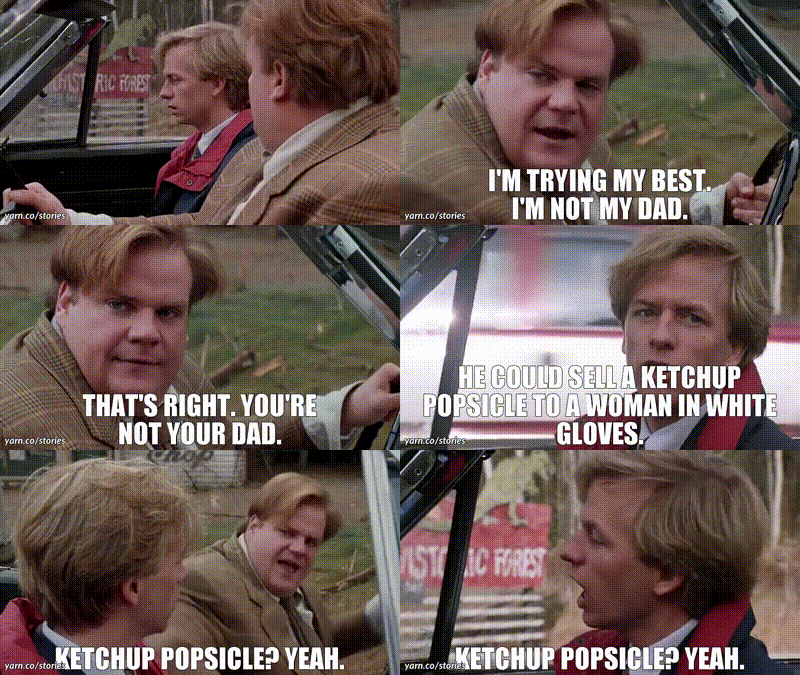
Needless to say, I don’t think that way.
For my entire career in 3D has really felt like I struck the jackpot. I graduated college and had no idea what I wanted to do. I was waiting tables and working odd jobs, and I was lucky enough to stumble into this 3D world and make a career of it, and I feel incredibly grateful for it. So I’ve always felt a very strong desire to give back to this community. And the best way I found to do that was by helping others.
It started with individuals through teaching and mentoring, and then it rolled into more pipeline work and helping entire companies set up their workflows. That led me to a passion for helping companies make cool things.
This BizDev job is just a continuation of that idea. I get to work with companies to get them the tools and workflow to be wildly successful in creating the incredible things they strive to make.
Mom Truth
When the offer became official, I was pumped. I was telling family about it, and my mom asked about the job, so I showed her the job description. She read through the list and asked…
Do you actually know how to do all of this?
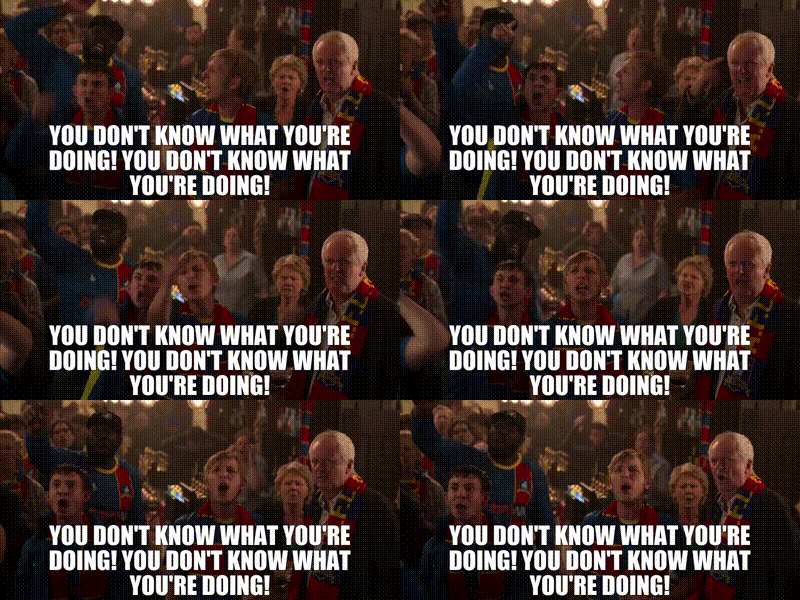
The honest answer was no, not really. But that’s kind of what we do as artists.
Nobody who’s walked into an unfamiliar creative project actually knew how to do it before they started. What they had was a faith that they could use the same brain that solved a million FATAL ERROR software crashes to problem-solve anything that may arise.

Who Am I?
New 3D Artist Merch!
New 3D Artist swag is here!
We ran a design contest inside the community, and Randy Mills took it home with a CMYK sweatshirt design that’s honestly too good not to wear.
Grab yours today.


3D News
Foundry releases Nuke 17.1 - CG Channel
Autodesk AI assistants for 3ds Max and Maya - CGPress
Scantic trains 3D Gaussian Splats entirely on your phone - CG Channel
Armature is a free AI-assisted standalone character rigging tool - CG Channel
Autodesk discontinues Mudbox - CGPress
CreativeRates tells you how much other people are earning in VFX - CG Channel
3D Job Spreadsheet
Link to Google Doc With A TON of Jobs in Animation (not operated by me)
Hello! Michael Tanzillo here. I am the Head of Technical Artists with the Substance 3D team at Adobe. Previously, I was a Senior Artist on animated films at Blue Sky Studios/Disney with credits including three Ice Age movies, two Rios, Peanuts, Ferdinand, Spies in Disguise, and Epic.
In addition to his work as an artist, I am the Co-Author of the book Lighting for Animation: The Visual Art of Storytelling and the Co-Founder of The Academy of Animated Art, an online school that has helped hundreds of artists around the world begin careers in Animation, Visual Effects, and Digital Imaging. I also created The 3D Artist Community on Skool and this newsletter.
www.michaeltanzillo.com
Free 3D Tutorials on the Michael Tanzillo YouTube Channel
Thanks for reading The 3D Artist! Subscribe for free to receive new posts and support my work. All views and opinions are my own!
I really appreciate the openness in this post. I believe any creative should chase what truly excites them and keeps their passion alive for creating amazing things. Like you, I sometimes get caught up in being the “company man,” staying too late to make the transition. I’ve also been on both sides of the pond, whether it’s building a visual team and leading the creative charge or joining an established team where I’m a supportive, skilled player maintaining the success over leading the next frontier for creative direction. Overall, I think you should follow what inspires you, which you’ve clearly done, and I’m excited for all the amazing things you’ll do at KB3D. Let Mike Reese and the team know I said hi 👋🏾