


There is a robot I keep showing people at parties. It’s called NEO, it’s made by a company called 1X, and it looks like somebody put a sock puppet in a baggy knit sweater and taught it to fold laundry. It’s soft. It slinks around your apartment like it’s trying not to wake anyone up. It’s creepy and I couldn’t tell if it was a joke at first, but I find myself sharing it with too many people.
I live in San Francisco, so my relationship with robots is already weird. Waymos are everywhere. Little delivery bots that look like BB-8’s cousin roll down the sidewalk past me on the way to coffee. None of that is science fiction anymore.
The map of 3D, and the blank spot on it
If you’ve been reading this newsletter for a while, you know the pitch. There’s the obvious 3D: film, VFX, games. Then there’s the 3D I’ve spent the last few years writing about, the stuff happening outside entertainment…fashion and footwear…product visualization…automotive design…industrial design…etc…
The list of companies that need people who can build a convincing object in 3D getting longer.
When people ask “what’s next,” the answers are usually some flavor of XR, immersive web, AR glasses, that kind of thing. All exciting and worth watching.
Robotics never makes the list. Nobody puts “humanoid robot startup” on the career map. But the funny thing is, these robotic companies really need 3D scenes and individuals to help set them up.
Figure has raised more than $6 billion. Apptronik closed a $935 million Series A in March. Tesla had about a thousand Optimus units working inside Giga Texas by June and is aiming for five thousand by the end of the year. 1X opened NEO preorders last October at $20,000, or $499 a month, and says it can build 25,000 of them a year. NVIDIA spent a big chunk of GTC 2026 on what it now calls “physical AI,” with 1X, Figure, Agility, Boston Dynamics, and NEURA all on stage as partners.
That’s robots for warehouses, factories, and, increasingly, homes. Robots that put dishes away. Robots that fold laundry. Robots that carry a box up the stairs.
I know, I know. A lot of you have a healthy skepticism about a camera-on-legs wandering around your house. I share that too. The NEO demos still lean on remote human operators for the harder tasks, and the robot’s ear lights turn blue so you know when a stranger in San Carlos is driving it.
But all weirdness aside many of us have a real reason why the success of these robots could be very helpful.
Aging with robots
I’m in my mid-forties now, which means I’ve entered the phase of life where you start worrying about your parents.
Mine are in their seventies. I’ve been lucky, they’re healthy, they’re active, they’re stubborn in all the ways I’m stubborn. But I’ve had grandparents in nursing homes. Even the good ones are a bummer. And the thing that moves people out of their own houses isn’t always a dramatic medical event. It’s the small physical stuff. The stairs. The laundry basket. Moving the box inside that used to be easy.
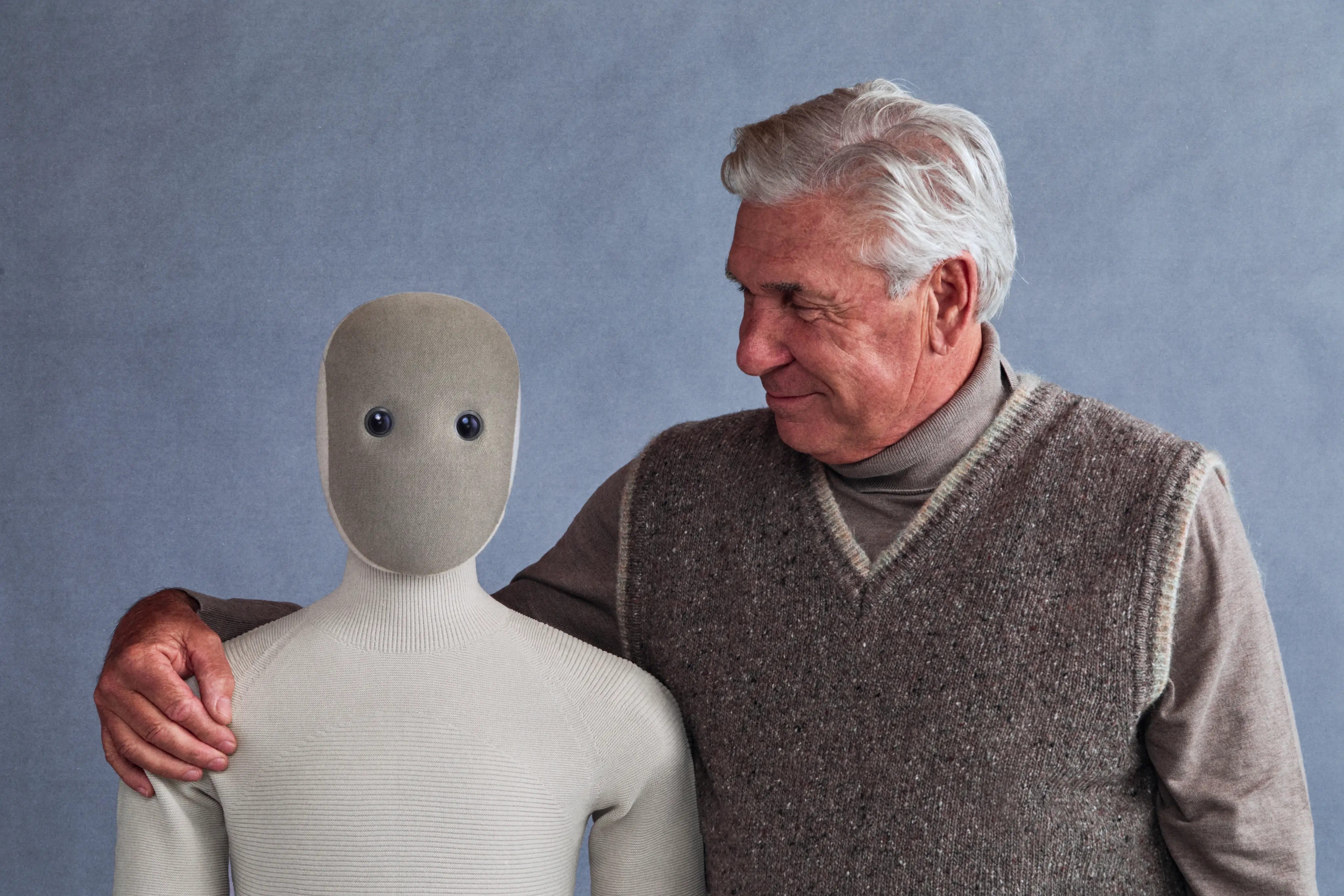
I want people to age with dignity. I want them to stay in their own homes as long as they possibly can. And I know, because I am one of them, that stubborn people do not ask for help until it’s too late. Something that can get on the step stool or pick up the thing off the floor, or just be there when nobody else is, changes how I look at these things.
There’s already a pilot in New Hampshire where a Hello Robot Stretch is helping an elderly couple stay in their house, reading prescription labels and bringing water. The oldest boomers are turning 80 this year and there aren’t enough home aides to go around. This isn’t hypothetical for a lot of families.
So, yes. I want the floppy sock puppet to work.
How a robot learns to put away your dishes
Here’s the problem these companies have, and here’s where you come in.
A robot has to be trained. It has to see a kitchen, and a dishwasher, and a mug, thousands of times before it can be trusted to not throw your mug into the dishwasher from across the room. 1X says NEO practices skills “thousands or even millions of times in simulation” before a new behavior gets anywhere near real hardware.

You can’t do that in the real world. You could build a warehouse with eighteen kitchens and fifteen living rooms, and companies do, but you will never build enough of them fast enough. The real world has infinite variables. Every coffee table is a different height. Every couch is a different color. Some people have a dog bed in the walkway and some people have a pile of Amazon boxes by the door that’s been there since March.
The answer is simulation. You build the kitchens in 3D and let the robot practice in those. And when a robot is learning to generalize, one kitchen is useless. You need the robot to see a thousand kitchens. NVIDIA’s whole GTC pitch this year was basically that they want to turn robotics’ data problem into a compute problem, which is a fancy way of saying “stop collecting the real world, generate it.”
Now think about what “a thousand kitchens” actually means in practice. Fifteen floor plans. Fifteen countertops. Fifteen fridges, fifteen sets of cabinets, a few dozen mugs, some plants, some lighting conditions, a window on this wall or that wall. Mix and match, and you’ve got millions of kitchens for a robot to stumble around in. The industry calls this domain randomization. We call it scene generation. Same idea, pointed at a different customer.
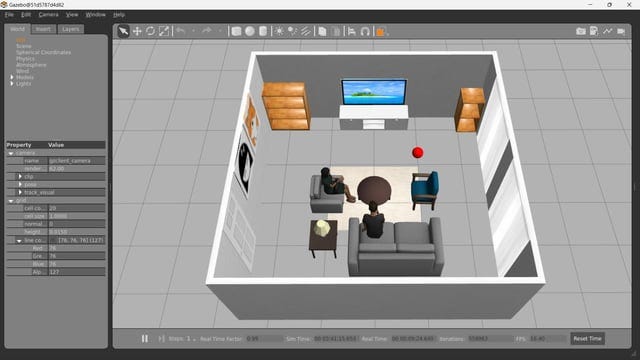
Here’s the part that surprised me. The people building these pipelines are saying out loud that assets are the bottleneck. NVIDIA’s free SimReady library, the one everybody starts with, has about a thousand hand-validated objects in it. One robotics asset company estimated a single mid-sized warehouse or kitchen needs somewhere between 10,000 and 100,000 distinct objects to train on properly. One rule of thumb I found: if your training set has objects “in the dozens rather than the thousands,” your robot is going to fall over in the real world. A policy trained on ten objects learns ten objects. Trained on a thousand, it learns objects.
Somebody has to make those thousand objects. Somebody has to make them look right, sit right, and have physics that behave like the real thing.
What a “sim-ready” asset actually is
This is where it gets specific, and where most of us have a head start we don’t know we have.
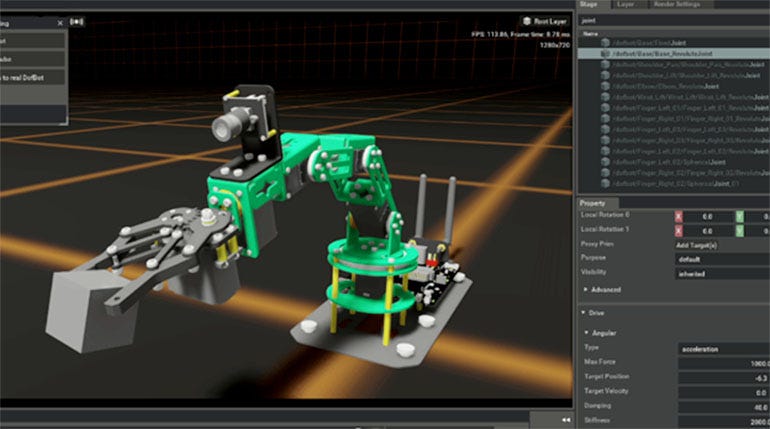
A robot training asset often lives in USD. It has correct scale, because a robot that trained on a mug that’s 40 centimeters tall is going to have a bad day. It has a collision mesh that’s separate from the pretty mesh. It has mass, friction, and restitution set so that when the robot drops it, it falls like a mug and not like a balloon. If it’s a cabinet or a drawer or a door, it has articulation, meaning real joints with real limits, so the robot can learn that drawers pull out and doors swing.
The simulators themselves are familiar too. NVIDIA’s Isaac Sim runs on Omniverse. Plenty of these teams are building environments in Unreal and Unity. The OpenAI simulation job I looked at literally lists “experience with modern game development practices” as a requirement, and pays $230K to $385K.
The generative tools are showing up here too. World Labs’ Marble can spit out a Gaussian splat of a kitchen from a text prompt, and NVIDIA published a workflow to drop it into Isaac Sim. The post itself admits what used to take weeks of modeling now takes hours, and then spends most of its length on the manual part: aligning it to the floor, scaling it to the real world, adding colliders, fixing lighting. Even in this AI workflow, the tool generates the kitchen, and a 3D artist who knows what a kitchen should look like makes it usable.
These jobs already exist, and they’re paying
General Robotics was hiring a Senior 3D Technical Artist at up to $205K to bring robot CAD into Unreal and Isaac Sim and build photogrammetry digital twins (See postings from this summer/fall below). Antioch is looking for technical artists to build sim-ready USD environments, with procedural scene generation and Gaussian splat tooling in the description. REVEL in Prague wants a Blender artist to model their humanoid and its props, visa and relocation included. Skild AI, which is working with ABB and Foxconn, has a Senior Robot Animator posting right now at $100K to $300K, and the requirements are keyframe animation in Maya or Blender and retargeting mocap onto non-human skeletons. That’s a character animator job with a robot in the chair. Meta, Toyota Research Institute, NEURA Robotics, and Parallel Domain have all had 3D roles come through this list in the last eighteen months.


And then there’s 1X. I counted. They have 99 open roles on their careers page. Most of them are hardware and manufacturing, which makes sense for a company trying to ship a robot. But in there: a Principal Tools Engineer for Simulation, a Simulation Engineer for Physics Modeling, a Staff Graphics Engineer for VR Teleoperation, a CAD Sculptor, and an entire softgoods team, because somebody has to design the sweater. Figure has 103 openings. Skild has 55. These companies are growing fast, with a lot of money behind them, and the 3D roles are starting to show up in the gaps between the engineers.
If I wanted in
Say you’re a 3D artist and you want to point your portfolio at this. Here’s what I’d do, and none of it requires a robotics degree.
I would build a room generator. Not one beautiful kitchen. A system. Take a modest library of assets, maybe twenty pieces of furniture, a handful of props, a few material sets, and build a tool in Blender or Houdini or Unreal that spits out a hundred bedrooms where nothing intersects, the layout makes sense, and the lighting varies. Export them to USD with correct scale and collision. Then show the hundred rooms in a grid, so a hiring manager understands in one image that you think in systems and not in hero shots.
I would learn what makes an asset sim-ready and make ten of them properly. A drawer that actually opens with limits. A mug with a real collision mesh and a believable mass. Put them in Isaac Sim, which is free, and drive a robot into them. Record it. It doesn’t have to be pretty. It has to work.
And I would learn the vocabulary. Domain randomization. Sim-to-real. Real2Sim. SimReady. Articulation. These are not hard concepts, they’re just words we don’t use, and the moment you use them correctly in an interview you stop being “a game artist who’s curious” and start being someone who understands the problem.
The engineers will collect the data and train the models. That’s their job. But every one of those models learns inside a room, and right now the rooms are the bottleneck.
Conclusion
This industry needs more 3D rooms than it can possibly make. It needs thousands of correct, boring, physically honest objects. It needs people who can build a system that produces ten thousand variations without falling apart. That is grunt work with a future in it, in a field that is only going to get bigger, for companies with more money than they know what to do with.
Nobody sent you an invitation because they don’t know they need you yet. They’re going to figure it out when the robot keeps trying to open a cabinet that was modeled with the hinge on the wrong side.
I’d rather you were already there when they do.

3D News Roundup
Google’s Genie 4 can now build a world you walk through, Maxon shipped the 2027 versions of everything, Netflix cut 1,000 people while telling them business is strong, and someone rebuilt 3ds Max inside Blender for fun.
Software & Tools
Maxon One release brings new versions of Cinema 4D, ZBrush, Redshift, Red Giant and Autograph - CGPress
3ds Max doppelgänger built on top of Blender - BlenderNation
SketchUp 2027 adds procedural modeling - CGPress
Plasticity 2026.2 gets its parts together - Digital Production
New Foundry video looks at use of Katana, Nuke, and USD by Pixar in Toy Story 5 - befores & afters
Animatica Marionette offers directable character animation inside Blender - CGPress
AI + 3D
Google’s Genie 4 world model adds audio, more realistic worlds, and real-time steering - TechCrunch
Tim Sweeney says Epic Games “aims to survive AI revolution” with AI pivot - Shacknews
Animation and VFX leaders discuss AI and jobs at VIEW Conference - Cartoon Brew
After a year of layoffs, Disney finds $180 million for recruits from bankrupt Character.AI - Cartoon Brew
Hi3D V1.0 goes open source, claims first production-validated open-source AI 3D model - PR Newswire
Industry News
“Our business is strong and growing,” Netflix tells employees as it lays off 1,000 of them - Cartoon Brew
EA shuts down BioWare, cancels Mass Effect game after $55 billion Saudi-led takeover - Cartoon Brew
Rockstar created about 600,000 animations for NPCs in GTA 6 - 80 Level
Who Am I?
New 3D Artist Merch!
New 3D Artist swag is here!
We ran a design contest inside the community, and Randy Mills took it home with a CMYK sweatshirt design that’s honestly too good not to wear.
Grab yours today.


3D Job Spreadsheet
Link to Google Doc With A TON of Jobs in Animation (not operated by me)
Hello! Michael Tanzillo here. I am the Senior Director of Business Development at KitBash3D (Greyscalegorilla, Artstation, Sketchfab). Previously, I was the Head of 3D Tech Artists at Adobe and a Senior Artist on animated films at Blue Sky Studios/Disney with credits including three Ice Age movies, two Rios, Peanuts, Ferdinand, Spies in Disguise, and Epic.
In addition to my work as an artist, I am the Co-Author of Lighting for Animation: The Visual Art of Storytelling and the Co-Founder of The Academy of Animated Art, an online school that has helped hundreds of artists around the world begin careers in Animation, Visual Effects, and Digital Imaging. I also created The 3D Artist Community and this newsletter.
www.michaeltanzillo.com
Free 3D Tutorials on the Michael Tanzillo YouTube Channel
Thanks for reading The 3D Artist! Subscribe for free to receive new posts and support my work. All views and opinions are my own!