

3D Artists + AI
Where things stand today

I have a happy trigger finger on social media.
Somebody posts “AI is coming for your 3D job? RIP Pixar!!!!” Mute.
“Everyone who touches AI is a talentless fraud.” Unfollow.
“Ten reasons the AI haters are wrong.” Unsubscribe

I don’t think I’m going on a ledge to say that this framing around AI is exhausting. So when the topic came up inside The 3D Artist Community recently, I was ready for some stories about people with extreme takes on AI. Instead, we got something I haven’t seen anywhere else online: working 3D professionals, across film, games, fashion, and product viz, talking honestly about where they and their companies actually stand with AI.
Nothing hyperbolic…just people in the middle of their careers trying to figure this thing out.
My way of processing anything is writing about it. So this week, a recap of what I’m hearing. Not an exhaustive take, just a snapshot of where we are right now.
For the record, my own stance is the most boring one possible: AI is fine. I don’t think it’s ending the world and I don’t think it’s replacing you. I use it daily for small tasks and for challenging my own assumptions when I write. I use Generative Fill in Photoshop. I play with it in 3D. I still make the work I care about the way I’ve always made it. The technology itself barely ranks among the things that worry me.
What worries me is the people around it.
The two ways companies get it wrong
Almost none of the frustration in our conversation pointed at the technology. Nearly all of it pointed at how companies are handling it. And they’re getting it wrong in two opposite directions at once.
On one end are the companies banning AI outright. That sounds responsible until you hear what actually happens: employees use it anyway, in secret. People in the community have heard coworkers say they photograph their screens with personal phones to feed a chatbot, or paste an email full of sensitive company data into a free consumer tool to punch up the wording. A hard ban just relocates the usage to the shadows, where the security practices are worst. If you take nothing else from this article, take this: don’t paste company data into tools your company hasn’t approved. That email you want rewritten has client names in it, dollar amounts, sensative information, or anything else you need to protect. A misplaced comma isn’t worth it.
On the other end are the companies forcing adoption.
Mandates from the top, AI in every workflow, usage tracked like a performance metric. Here’s what that actually produces: babysitters. Every AI output has to be validated for accuracy, liability, and brand consistency, and that validation often takes longer than just doing the task the old way. People in the community described watching pipelines that worked perfectly well get slower because someone upstream decided AI had to be wedged into them.
A ban and a mandate sound like opposite philosophies. They fail for the same reason. Both start with the technology and ignore the person doing the work.
Don’t ask, don’t tell
The part of the conversation that stuck with me most was about silence.
Several artists described a don’t-ask-don’t-tell culture at their studios. Curious people experimenting quietly, learning these tools on their own time, and saying nothing publicly. They’ve seen the public backlash to artists trying AI tools and they don’t want any part of it.
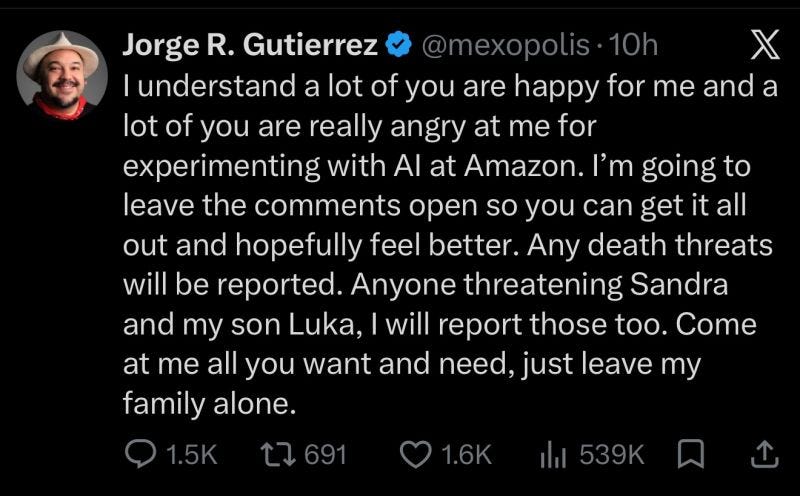
Just a couple of weeks ago, Jorge Gutierrez, the creator of The Book of Life and Maya and the Three, announced an animated series called Punky Duck under Amazon’s new GenAI Creators’ Fund. The backlash hit within a day. He received death threats, and so did his wife and son. Forty-eight hours after the announcement, he dropped out of the project entirely. This is a beloved artist who spent decades championing handcrafted animation, and his family was threatened over an experiment.
The loud anti-AI voices have gotten louder, and they feel empowered right now. So you get this surreal dynamic: someone stands up in a meeting and declares that everyone using AI is destroying the industry, and then ten people quietly huddle afterward to swap notes on what they’ve been trying. It forces people to test underground, which means the people figuring out the smartest uses of these tools can’t share what they’re learning with the colleagues who’d benefit most.
One artist in our community worked in the model shop at ILM when CG started replacing physical models. She said the energy right now feels familiar. There was the same resistance then, the same anger, the same declarations that the new thing was the death of the craft. The people who adapted kept working. The people who refused, stopped.
The advice was to basically pick your hills carefully, because some of them are career-ending. I wrote about a version of this fear last year, and her framing has been rattling around my head ever since. She wasn’t saying resistance is wrong. She was saying it has a price, and you should know the price before you commit.

The money question
Another thread worth sharing: none of these AI companies are profitable. They’re venture-backed and burning cash to win market share, the exact playbook Uber and Airbnb ran a decade ago. Users first, profits eventually, prices low until the market is captured.
But AI has a problem those companies didn’t have at this scale. The overhead never goes away. Data centers get talked about like factories, build them once and process forever, but the GPUs inside them wear out and get outpaced constantly. Analysts are now openly debating whether the real economic life of these chips is closer to two or three years than the five or six on the books, and Michael Burry estimates the biggest players will understate depreciation by a combined $176 billion between 2026 and 2028. Tom’s Hardware has called GPU depreciation the next big crisis coming for AI hyperscalers. Running these models is brutally expensive, and right now users are paying a fraction of what it costs.

VCs are not charities. At some point they want their return, and the path there is higher prices. Ubers used to cost half what a taxi did. Now check your receipt. It is entirely possible that some AI-dependent workflows being built today will stop making financial sense once the subsidized era ends, and “I’ll just hire a human again” becomes the cheaper option. Worth keeping in mind before you rebuild your whole pipeline around a tool whose real price you haven’t seen yet.
The layoff story
Here’s the most cynical thing we discussed.
Companies are conducting layoffs right now and crediting AI for them. Put yourself in the leadership seat. You can tell your shareholders “we planned poorly, made the wrong bets, and people lost their jobs because of our decisions.”
Or you can say “we’ve adopted AI, become dramatically more efficient, and streamlined our workforce.”
One of those stories tanks your stock and your reputation. The other gets you a glowing writeup about innovation.
The layoffs would have happened either way. AI is just the better press release. Which means a lot of the “AI is taking jobs” panic is built on companies borrowing AI as cover for ordinary mismanagement.
What good adoption actually looks like
The companies that are adopting these tools well all follow the same playbook regardless of industry. It starts with a person and a problem, not a technology and a mandate.
I write a lot, so my problem was keeping track of everything I’ve written and thought. I keep all of it (articles, my journal, my wife’s shift schedule, my kids’ summer camp schedule) in Obsidian, and I use Claude to read across it. It catches when I’m repeating myself. It tells me when my last ten articles share a bias I haven’t noticed and pushes back on my assumptions. It reminds me that my kids actually need to be picked up an hour earlier than the normal time today.
I built that because I had a specific problem, and the tool happened to solve it.
A creative lead in fashion who’s in the community did the same thing from a completely different angle. His team was drowning in repetitive Browzwear work, so he trained AI on automation scripts for those tasks. It worked because he identified the problem first and then looked for a tool. That’s the same argument I made about software in general.

The value was never the tool, it was understanding the work well enough to know where a tool helps. So many companies run it backwards. They buy the technology, hand it to artists, and say “go figure out how to use this.”
And if you’re sitting there feeling like everyone else has this figured out already, they don’t. Half the conversation was accomplished professionals admitting they’re improvising.
Conclusion
So that’s the snapshot. The technology is fine, unevenly useful, occasionally impressive, frequently overhyped. The bans are failing, the mandates are failing, the layoff narratives are mostly cover, and the real progress is happening quietly, artist by artist, problem by problem, often in workplaces where nobody feels safe saying so out loud.
Who Am I?
3D Merch is here and we have a new hoodie!

3D News
Oddly Satisfying Render Challenge Winners Announced! - Framerate.tv
Open-Source 4DGS Might Be the Future of Video: From iPhone Footage to Interactive 3D Space - Reddit
Sparseal Announces New AI-Assisted Retopology Tool - 80.lv
Retopo CAD Models in Maya - LinkedIn
Houdini 22 Sneak Peek - YouTube
3D Job Spreadsheet
Link to Google Doc With A TON of Jobs in Animation (not operated by me)
Hello! Michael Tanzillo here. I am the Head of Technical Artists with the Substance 3D team at Adobe. Previously, I was a Senior Artist on animated films at Blue Sky Studios/Disney with credits including three Ice Age movies, two Rios, Peanuts, Ferdinand, Spies in Disguise, and Epic.
In addition to his work as an artist, I am the Co-Author of the book Lighting for Animation: The Visual Art of Storytelling and the Co-Founder of The Academy of Animated Art, an online school that has helped hundreds of artists around the world begin careers in Animation, Visual Effects, and Digital Imaging. I also created The 3D Artist Community on Skool and this newsletter.
www.michaeltanzillo.com
Free 3D Tutorials on the Michael Tanzillo YouTube Channel
Thanks for reading The 3D Artist! Subscribe for free to receive new posts and support my work. All views and opinions are my own!